Why am I an artist? I don't know if I really have a good answer to that. A better question, at least to begin with, might be 'Do I want to be an artist?' It is a straight and yet hard question. I am pretty sure, most of the time, that I do indeed want to be an artist, although I don't know that I am always capable of being one. Certainly it does not feel as if I have been one for some time now, with my artistic life lying somewhat dormant.
Being an artist is about the only thing I can really remember ever wanting to be (other than a spaceman, which did not last far past the end of Return of the Jedi). I've been drawing and painting for as long as I can remember. However, there is a world of difference between having an aptitude for something and being able to do it as a career. Being an artist is not simply about being able to create the work, and goodness knows that is enough of a challenge in itself. Being an artist is to be a small business, requiring a whole host of business-related activity, all whirring away behind the smiling face of the artist, or the works created.
It's a hard road to travel and one that pretty much requires an almost sociopathic level of self-belief and drive enough to circumnavigate the solar system. I exagerate, of course, nevertheless the point holds, in that self-belief and drive and essential. Without them, paintings, when they get made, build up slowly in storage and the world has no idea that they are there. Viscous negative cycles commence.
Once again, I am writing in the third person, but I am fooling no one. Why am I an artist? It's a good question. I'm going to need to think about this some more.

Showing posts with label thoughts. Show all posts
Showing posts with label thoughts. Show all posts
Friday, 16 August 2013


Friday, 14 September 2012
A little bit of background
It has been an unusual week of painting. Right at the start of it, there was a revelation of sorts that led me to feeling somewhat more relaxed, perhaps even more philosophical, about my life as an artist. Acting on this feeling, I began three new paintings this week, which marks a definite increase in my recent productivity. I even took the time after the initial painting session for each piece, to sit down and write something about where the piece came from, my intentions for it and my initial feelings about it.
On the first day, I once again addressed the darkness that has been my shadow for the past month. Rather unexpectedly, colour made an appearance. After the initial session, I wrote this:
"The darkness has often times served as a pretty direct visual representation of the dark emotions within: doubt, fear, depression and so on. Today the darkness seems perhaps transmuted. Still, of course, it is the darkness within, yet somehow now it is also a gestalt, the body in which everything else rests. What does this say about my self image? It suggests that I view myself as an essentially dark person, with a warm, friendly (orange represented) public countenance, that is nonetheless covering dark things. Am I truly thus? In today's representation deep red mixes with, and breaks through, the darkness. It does not feel a red of anger, rather one of love and passion. It is hidden, well below the surface, yet it is clearly there, widespread and of undoubted importance."
Later, while reworking this painting, the red became somewhat submerged, too lessen its impact. I had realised that it was too jarring and while my intent for each painting it to describe a particular instant in my life, at the same time I have not become so obsessed with the idea that I am prepared to sacrifice aesthetics. There are elements of this painting that I am very happy with, as well as some that may require more work. It is resting currently. I will look again at it in a few days.
On the second day, an entirely different set of circumstances presented themselves for posterity. The painting that resulted was a surprise, being something of a departure from what could loosely be called my style. It is more organic in shape, less geometric, and overall feels looser. I wrote this:
"Overwhelmed. It is a common feeling these days. Too much information, too fast, too many choices. Today, however, it is the overwhelming size and complexity of visa/immigration issues. In particular, I feel small and insignificant, unable to cope with the vast cliff that needs to be negotiated. Today I gave that immense weight to a crushing wave, an avalanche grinding and drowning. Over run by it, I am forced to the ground, torn and battered. The mass of the problem is complex, aswirl, impenetrable. The remorseless, cold press of the world. It is an enormous stew that fills almost everything, there is no way to escape it, nowhere to turn, it is everywhere. It is the immensity of any overwhelming problem, where an objective viewpoint is hard to come by. Seen from below, there is no way out."
Unlike the previous day's painting, which I felt sure of and able to rework into something more suitable to my sensibilities, this piece has remained relatively static. Perhaps this is a reflection of the subject matter. Who, after all, is very good at coping with something overwhelming? I've made numerous tiny tweaks to this, yet there is something unsettling in it. Only time will tell whether or not I can live with this.
On the third day, things did not work out quite as well. 'Isolation' was the idea that was on my mind that day, both it its physical and mental manifestations. I had an idea that seemed an ideal way to represent the theme, however it was too concrete, conceivably as a reaction to the overly-organic painting of the day before. It drew too heavily upon my graphic designer's eye and as a painting, it simply would not work. I spent a couple of days working at it, trying to resolve its blocky solidity, however as yet I have been unable to find resolution. Presently, there is almost nothing left of the painting and it has been demoted to non-painting status for the time being.
Each of these three paintings were conceived as ways of interpreting three seemingly quite separate feelings and moments, yet they are also quite clearly linked. The forms and colours (at least of these two) are only the most obvious link. Deeper inside both them, and inside myself, I can construct a conversation between the pieces, a web of common thoughts and ideas.
These three new paintings, more than ever seem almost journalistic. I do not know if I can always work like this – the self awareness and concentration needed is great – and even if I find the energy and the ability, spending so much time looking inwards may not be a very healthy way to spend my time.
It has been an unusual week, I wonder what the next one will hold.
On the first day, I once again addressed the darkness that has been my shadow for the past month. Rather unexpectedly, colour made an appearance. After the initial session, I wrote this:
 |
| (work in progress) Mixed media on panel, 12x12" |
Later, while reworking this painting, the red became somewhat submerged, too lessen its impact. I had realised that it was too jarring and while my intent for each painting it to describe a particular instant in my life, at the same time I have not become so obsessed with the idea that I am prepared to sacrifice aesthetics. There are elements of this painting that I am very happy with, as well as some that may require more work. It is resting currently. I will look again at it in a few days.
On the second day, an entirely different set of circumstances presented themselves for posterity. The painting that resulted was a surprise, being something of a departure from what could loosely be called my style. It is more organic in shape, less geometric, and overall feels looser. I wrote this:
 |
| (work in progress) Mixed media on panel, 12x12" |
Unlike the previous day's painting, which I felt sure of and able to rework into something more suitable to my sensibilities, this piece has remained relatively static. Perhaps this is a reflection of the subject matter. Who, after all, is very good at coping with something overwhelming? I've made numerous tiny tweaks to this, yet there is something unsettling in it. Only time will tell whether or not I can live with this.
On the third day, things did not work out quite as well. 'Isolation' was the idea that was on my mind that day, both it its physical and mental manifestations. I had an idea that seemed an ideal way to represent the theme, however it was too concrete, conceivably as a reaction to the overly-organic painting of the day before. It drew too heavily upon my graphic designer's eye and as a painting, it simply would not work. I spent a couple of days working at it, trying to resolve its blocky solidity, however as yet I have been unable to find resolution. Presently, there is almost nothing left of the painting and it has been demoted to non-painting status for the time being.
Each of these three paintings were conceived as ways of interpreting three seemingly quite separate feelings and moments, yet they are also quite clearly linked. The forms and colours (at least of these two) are only the most obvious link. Deeper inside both them, and inside myself, I can construct a conversation between the pieces, a web of common thoughts and ideas.
These three new paintings, more than ever seem almost journalistic. I do not know if I can always work like this – the self awareness and concentration needed is great – and even if I find the energy and the ability, spending so much time looking inwards may not be a very healthy way to spend my time.
It has been an unusual week, I wonder what the next one will hold.
Saturday, 7 July 2012
Uncharted territory
To most people, the art world appears as an exclusive clique, where one cannot simply enjoy a piece of work, one must exhaustively explain why, using the longest words available; a world where one must understand what the direct expressivity of artistic material is; a world where a seemingly discarded piece of everyday junk becomes art when placed on a plinth or a gallery floor. It is not a welcoming world and one must pass stringent entrance exams to gain admittance, or else as a visitor carry the fear of possible public mockery.
This preconception of the art world is one that appears to have gathered strength over the past century as art, or at least its cutting edge, has moved steadily away from strictly representational art.
Through the history of art, paintings have been almost always representational, meaning that their subjects were of something identifiable – a flower, a nude, a landscape and so on. While the more cunning artists would at times bury meanings within their paintings, for the mass of viewers it was quite clear what the painting was of.
In the nineteenth century, when artists such as Joseph Mallord William Turner and the French Impressionists stepped away from strict representation, a degree of explanation was needed to educate viewers to a whole new way of not just painting, but of looking at the world. In the twentieth century, when representational art was overtaken by non-representational art, the radical ideas of the Impressionists were advanced ever more radically. In this new and non-representational art, there was no longer a clearly defined subject and so longer explanations were required. Or perhaps the artists, curators and other full-time denizens of the art world simply felt them necessary, in order to justify themselves.
Over the course of the previous century, those explanations became longer and longer. With time, art moved on again, from the non-representational with an explanation to, more or less, simply the explanation. This two-century move from what once may have been perceived as little more than a pretty picture, to something with almost no aesthetic appeal and a long explanation, has served to turn art into an intellectual pursuit. As such, its potential mass appeal has been considerably lessened. This may be why the popularity of artists such as Claude Monet and Vincent Van Gogh continues, since arguably they were among the last cutting edge artists to paint more or less representationally.
In the first decade of the twenty-first century, as western affluence rose, so to did the disconnection between art and the public. Most people's experience of contemporary art became little more than reading in disbelief an article about the latest Turner Prize winner, or else about the escapades of a previous winners-turned celebratory millionaire.
Yet in the past few years, western affluence has been in a steady decline. This has helped reveal that many other institutions, most notably politics, banking and the media, seem to be reaching a similarly great point of disconnection with the public. For these institutions change has become not just something to be hoped for but something that would seemingly have become unavoidable. In the world of art, change appears already to be underway.
As the traditional methods for the dissemination of knowledge about art have lost either their credibility or their funding, and as with so much of our lives, the internet has taken over. Here is a quiet revolution, where much of the media and countless galleries who continue to peddle artistic alienation are being left for dead.
Through social media sites and online market places, the barriers that many saw between themselves and art are being pierced. So to in the real world, friendly faces are replacing stern and consequently, more and more people are becoming aware of the value of having art in their lives. It is a realisation that I experienced a few years ago, when I bought my first piece of art. I can vividly recall the experience.
I saw a painting I liked in an Etsy store, made by someone I knew only slightly (then) through a social media site. I liked it and realised that since it was a small paper piece, I could afford to buy it. This simple access to original art was a revelation. I saw how easy it was to own art and quite possibly always had been. For the life of me, I could not understand why I had never bought any before. So it was that with one or two mouse clicks, I became the owner of a piece of original art. In the time since then, I have bought (and traded) several more pieces of art and now have a collection that includes the work of more than ten artists. Buying art, I now realise, is like buying anything else. There is no great drama to it, no need for endless pondering or justification. If I see a piece that I like, I can simply buy it, or else negotiate payments or a trade. It is simple knowledge that I wish I had possessed for so much longer.
While most of these pieces in my collection are small, they are indistinguishably real and original art and they are on my walls. To sit among them is an indescribably pleasant feeling. I know each of the artists who made the work and so feel a personal connection to the pieces. I also feel that here, finally, is something permanent in my life, something that will with luck out last me and that perhaps some future generation will hold and enjoy and know that it was part of my life.
Paintings may still seem to many an unaffordable luxury, something only for those in the know. Happily this is an attitude that is changing. Although few of us might have the affluence we once did, we are now making our purchases armed with more knowledge and eager to shop ethically. Maybe now, rather than considering the next electronic gadget from a multinational corporation, a corporation that may well be both eroding your rights and employing semi-slaves, it is time to buy a painting from a real, live artist, an artist who will almost certainly be grateful because you have bought them more time to be an artist.
This preconception of the art world is one that appears to have gathered strength over the past century as art, or at least its cutting edge, has moved steadily away from strictly representational art.
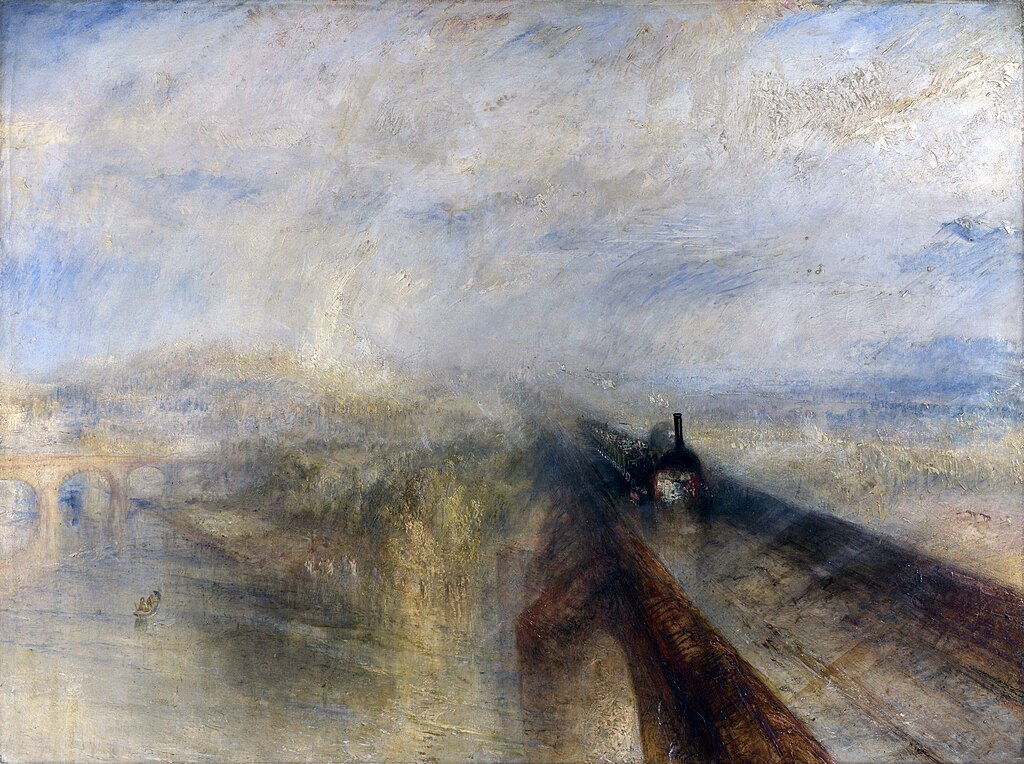 |
| Rain, Steam and Speed – The Great Western Railway Oil on canvas, 1844, JMW Turner Bequest to the National Gallery, London |
In the nineteenth century, when artists such as Joseph Mallord William Turner and the French Impressionists stepped away from strict representation, a degree of explanation was needed to educate viewers to a whole new way of not just painting, but of looking at the world. In the twentieth century, when representational art was overtaken by non-representational art, the radical ideas of the Impressionists were advanced ever more radically. In this new and non-representational art, there was no longer a clearly defined subject and so longer explanations were required. Or perhaps the artists, curators and other full-time denizens of the art world simply felt them necessary, in order to justify themselves.
Over the course of the previous century, those explanations became longer and longer. With time, art moved on again, from the non-representational with an explanation to, more or less, simply the explanation. This two-century move from what once may have been perceived as little more than a pretty picture, to something with almost no aesthetic appeal and a long explanation, has served to turn art into an intellectual pursuit. As such, its potential mass appeal has been considerably lessened. This may be why the popularity of artists such as Claude Monet and Vincent Van Gogh continues, since arguably they were among the last cutting edge artists to paint more or less representationally.
 |
| My bed Mattress, pillows, linens, objcets © 1998 Tracey Emin / Saatchi Gallery |
Yet in the past few years, western affluence has been in a steady decline. This has helped reveal that many other institutions, most notably politics, banking and the media, seem to be reaching a similarly great point of disconnection with the public. For these institutions change has become not just something to be hoped for but something that would seemingly have become unavoidable. In the world of art, change appears already to be underway.
As the traditional methods for the dissemination of knowledge about art have lost either their credibility or their funding, and as with so much of our lives, the internet has taken over. Here is a quiet revolution, where much of the media and countless galleries who continue to peddle artistic alienation are being left for dead.
 |
Dissolution chemistry
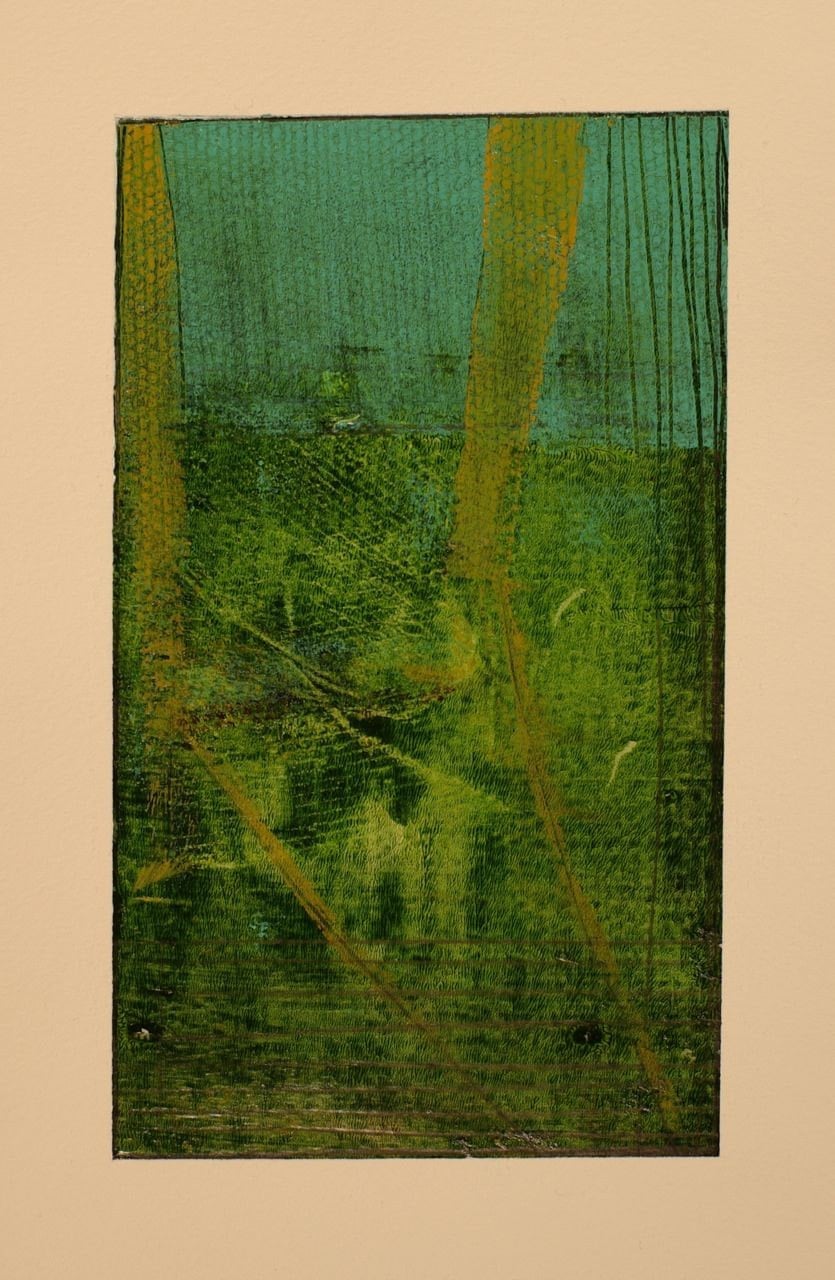
Mixed media on paper © 2009 Megan Chapman |
I saw a painting I liked in an Etsy store, made by someone I knew only slightly (then) through a social media site. I liked it and realised that since it was a small paper piece, I could afford to buy it. This simple access to original art was a revelation. I saw how easy it was to own art and quite possibly always had been. For the life of me, I could not understand why I had never bought any before. So it was that with one or two mouse clicks, I became the owner of a piece of original art. In the time since then, I have bought (and traded) several more pieces of art and now have a collection that includes the work of more than ten artists. Buying art, I now realise, is like buying anything else. There is no great drama to it, no need for endless pondering or justification. If I see a piece that I like, I can simply buy it, or else negotiate payments or a trade. It is simple knowledge that I wish I had possessed for so much longer.
While most of these pieces in my collection are small, they are indistinguishably real and original art and they are on my walls. To sit among them is an indescribably pleasant feeling. I know each of the artists who made the work and so feel a personal connection to the pieces. I also feel that here, finally, is something permanent in my life, something that will with luck out last me and that perhaps some future generation will hold and enjoy and know that it was part of my life.
 |
| Uncharted territory Mixed media on panel © 2012 Megan Chapman & Stewart Bremner |
Friday, 12 August 2011
Crack that dam

For me, at times, I feel there is inside me something that roughly equates to a reservoir, where my artistic drive is stored. Over time, it fills, with ideas, with motivation, with energy. I never know quite when it will overflow, what incident, fragment of a thought, image seen out of the corner of my eye, word from a lover, brush stroke in another's painting, or simply some random confluence of events, will cause it to crack, yet I know that it will at some point. The motivation, the ideas, the need to paint will rise and I will simply have to paint. It happens time and again and it is all I can do to ride that wave for all that it is worth.
Right now, my reservoir is filling. Whilst that happens, I think and I look and I talk and I take photographs. One day soon, I will paint again.
Friday, 8 July 2011
All you need to do is turn up
Today has been a victory because I have painted. Today has not been a victory, although for slight more complicated reasons.
Being an artist may seem to many an easy life: all one needs is to have a bit of talent, some technical skills, materials and a studio. From then onwards, one just turns up. Sadly, that's not the case. As an artist, as a painter, most of my professional working time is not spent painting. Rather, most of the time is spent thinking about art, looking at art and fretting about art. In particular, fretting about my own art.
When I making a painting well, the feeling is incomparable. It is sublime. It is what I live for, yet it is a fleeting moment. When I am not in that moment and the periods bookending it, doubt will all to frequently creep in. I doubt that I can ever break free of the painting the same idea ad nauseum ("how do I paint something new?"), I doubt that I will ever progress ("where do I go from here?") and I doubt whether I can, or even will, paint ever again.
Painting is a balancing act. To do it well, an artist needs to walk the line between order and chaos, between head and heart and between joy and doubt. Artists use all their skills and their materials to walk that line and it is a line they walk almost always alone, because painting is mostly a solitary process. It is a process of reaching within, subject to and powered entirely by one's own energy. It is an incredibly personal mode of expression, where often as not one is laying bare ones inner-most being. To explore these depths, to pull out the material needed, to mine one's soul, is an intensive and tiring process that is simply not sustainable over lengthy periods of time. Those creative moments are then limited and, in the fallow periods that exist between them, the doubts bloom.
With the recent completion of my Life is the Process series, with nothing but a void of empty, gessoed paper in front of me, today I face these doubts. However, I painted, I made marks and for a while I lost myself in the work. I have started to address the question "Where do I go from here?", even though as yet I have no answer. And so I clutch desperately at my tube of cadmium orange and I stand in front of those sheets of gessoed paper and I wonder "How do I paint?"
 |
| Dominance © 2011 Stewart Bremner Mixed media on paper |
When I making a painting well, the feeling is incomparable. It is sublime. It is what I live for, yet it is a fleeting moment. When I am not in that moment and the periods bookending it, doubt will all to frequently creep in. I doubt that I can ever break free of the painting the same idea ad nauseum ("how do I paint something new?"), I doubt that I will ever progress ("where do I go from here?") and I doubt whether I can, or even will, paint ever again.
 |
| Divergence © 2011 Stewart Bremner Mixed media on paper |
With the recent completion of my Life is the Process series, with nothing but a void of empty, gessoed paper in front of me, today I face these doubts. However, I painted, I made marks and for a while I lost myself in the work. I have started to address the question "Where do I go from here?", even though as yet I have no answer. And so I clutch desperately at my tube of cadmium orange and I stand in front of those sheets of gessoed paper and I wonder "How do I paint?"
Friday, 15 April 2011
Still some hitches
With just a little too much to be doing and thinking about right now, painting seems to have slid down my priorities a little. Not that I didn't paint at all. I worked on two different pieces from February that were unfinished. It seemed, when I began this, a good idea, a way to ease back into painting. However, it proved to be rather frustrating, as I tried to work these paintings out of their dead ends. Right now, my efforts seem to have done little more than simply move materials around the paper, so that rather than fix the existing problem pieces, I have merely changed the problem.
With hindsight, I probably ought to have warmed up with a few small pieces first. That, then, may be the plan for next week.
With hindsight, I probably ought to have warmed up with a few small pieces first. That, then, may be the plan for next week.
Friday, 8 April 2011
Slow (re)starter
It has been yet another slow art week. An unexpected hangover from the intense month gone meant that painting was not really on the cards this week. However, I did spend some time with my finished paintings, looking at the marks and the shapes and just generally being amazed that these works actually came from my hands. After the recent darkness, it was a welcome reminder.
I also made a first attempt at naming the four finished pieces this week. So far, this has only been successful on one painting. More time just sitting with them will with luck cure that problem.
I also made a first attempt at naming the four finished pieces this week. So far, this has only been successful on one painting. More time just sitting with them will with luck cure that problem.
Friday, 1 April 2011
Almost there
Last weekend, sadly, art did not happen. After another long week of uninspiration, I came down with yet another office-related bug and spent far more of the weekend on the sofa that I had planned to. Today sees my last day in that buggy office and so from tomorrow onwards, I return to a more creative and free world (also one that has considerably less income, but you can't have everything). Quite how this will mesh with the body of work I was creating when I began this four week sentence is hard to forecast. My intention is to let events and my hands move as they will and to try not to worry about it. Wish me luck!
Friday, 25 March 2011
A little way from finishing
As the weeks of daily office work mount up, its effect on my art becomes apparent. Most notably, it limits the time I can paint down to just weekends, as there is not enough head room on workday evenings to even contemplate painting. So each weekend I work on my paintings, however I am yet to finish one. Instead, the five day breaks between sessions mean that when I return to work on a piece, the original motivation for the work has altered. To work on further in light of this means either to make a mess of the piece, or to alter is so fully that the original idea is irrecoverably altered. Rather than risk falling into either of these situations, I have been putting half-worked pieces aside, to complete when I return to painting daily in a week's time. These are the thoughts in my head as I head into one last office life weekend.
Friday, 4 March 2011
With added relish
Over the past month, my painting journey has involved not only painting every single day, but also an awful lot of thinking about art and talking about art and then thinking some more about art. A cycle of thinking and talking and writing, with intense burst of painting mixed in. It has been a head-bending time, as I've grappled with concepts that I have both never considered and avoided, as well as creating paintings that I had never expected to. I've uttered surprising statements and watched amazed at some of the shapes flowing under my brushes.

Those brushes have become notably freer too, perhaps even more painterly, as I move further and further from my controlled, graphic nature. I've become more familiar with my materials, with the various consistencies and tones of my acrylics and the way their mixed pigments split in water. I've also began to re-discover materials I had not used in many years – pastel, oil pastel, oil sticks and hard pencils – which I have been adding to those acrylics to give texture, depth and shape.

My goal in all this is to capture something of the changes to my manner of thinking, my manner of perception, that I have spent the last few years working to alter to the positive. The underlying framework for each piece therefore becomes an interpretation of how I see the world and myself, of the past, the present and the future. More specifically, the pieces become a reflection of my state at the moment that my brushes, pencils, rags, roller and pastels move on the paper.

The three pieces I am sharing today, all as yet unnamed, are the first three finished paintings I have completed to my satisfaction in quite some time. It is only this week that I feel I have finally got to where I wanted to get and that, right now, is only the beginning. I do not know what will come next but I am looking forward to it with relish.
Friday, 25 February 2011
Be here now

The first full week in my revised studio space has seen some bold and positive steps in my work. The space and the scale afforded me has given more freedom than I have experienced in a long time when painting.
For most of the week I continued to work on newspaper, although the rate of their progression slowed to less than one a day, as I began to narrow down my scope and focus more on a goal. Gradually, more and more time was spent on each piece. By the middle of the week, after some long and hard thinking, I decided it was time to move to a more permanent setting and so bought some heavy-weight paper.
As I sit here, on this sunny Friday afternoon, my fingers are spotted and smeared with paint, ink and pastel. A new piece, painted on some of that heavy, heavy paper is behind me drying. It may well be the start.
Friday, 18 February 2011
I read the news today
After the small throwaway paintings reached their end, I wanted to keep painting every day yet not on the same restricted A4 scale. The next logical step, to me, was to move to newsprint, specifically newspaper pages, which I would gesso then paint on.

Whilst the first couple were made in the much same manner as the smaller pieces, they soon began to move into markedly different territory. I wanted to challenge my habit of drawing shapes and then colouring them in, a recurring pattern from my pop art that seemed to have been creeping back. This took me off in an unexpected direction and whilst I had been thinking Motherwell in my head, Miro seemed to come out of my brush. The ongoing evolution continues, however, and that moment has already passed.
The increased scale is a joy to work on, giving me more freedom in my movement, allowing my brushes to slide with more fluidity. The contents of the pages under the gesso has also been interesting, adding textures and shapes where I have allowed it to show through. The pieces feel a little more mature than the smaller works. Which is good, as I am now starting to think about my next body of work, about what I want it to say.
The other big change this week has been in my studio. I've moved my furniture around and where once I had a painting corner of my living room, now I have a living corner in my studio. It is a better use of the room and the increased space is going to be great to work in.

Thursday, 27 May 2010
Thoughts on strings and things
The Lagrangian series is about balance, about finding the point between order and chaos where the two divergent forces exert an equal pull. In this respect it as as much a reflection of the world as it is a personal exploration of the artist's psyche.
The forces of chaos come first, represented by the rough, swooping texture of plaster, the bedrock on which everything else is built. Next come the random daubs, splashes and splatters of paint, that run across the works, still an element of chaos but one where the creator's hand is more evident.
Order's first implementation is through the dividing strings, that dissect the canvas, a fencing-in of areas that reflects our most basic urges to divide reality into mine/yours, us/them, here/there, to divide and conquer nature. The colouring of these areas then adds to and strengthens the imposed order, yet is never able to entirely disguise the chaos below. There is therefore no single part of the canvas where either order of chaos are completely dominant and so a balance is achieved.
The text in representative of society, our lives and our communications. The words themselves become almost meaningless, instead rather it is the balance achieved between the phrase (the many) and the single word (the individual) that is the focus. However, in each individual canvas, a further balance is sought between the meanings of phrase and the single word. What can at first seem to be a phrase with a single, ordered meaning, is pulled into question by the ambiguous comment. A balance of sorts.
(notes for future thinking)
*What is the significance of the landscape drawings?
*What is the reason for using harmonious colours?
*Why, as ever, do I always seek to disguise my brush strokes?
Tuesday, 2 March 2010
Lagrangian point
I've spent ten years filtering my creativity though the ordered side of my personality; the chaotic side was utterly banished. It was never a conscious choice, in fact almost entirely the opposite. I became disconnected from my art because it was an expression of only half of who I was – an utterly ordered person is not the same at all as one who walks the line between order and chaos.
An Lagrangian point is a point in space between two astral bodies where their gravitational pulls are equal and so cancel each other out. A third body placed at this point will be attracted towards neither and will remain stationary. This is where I want to be, in between order and chaos, feeling the pull of both but moving towards neither.
An Lagrangian point is a point in space between two astral bodies where their gravitational pulls are equal and so cancel each other out. A third body placed at this point will be attracted towards neither and will remain stationary. This is where I want to be, in between order and chaos, feeling the pull of both but moving towards neither.
Subscribe to:
Posts (Atom)