Showing posts with label Fashion Art. Show all posts

Wednesday, 3 April 2013

A tale of sound and fury

A few days ago, I walked out of the Scottish National Gallery of Modern Art so angry I could hardly speak – vibrating, nostrils flaring, teeth locked, brows knitted – angry enough to step out in front of, and face down, a speeding car on the pedestrian crossing outside. I left with a desire to never ever return to the gallery. I left hating art.

The SNGMO's current exhibition, From Death to Death and Other Small Tales features pieces from the gallery's collection that have been mixed together with a Greek billionaire's private collection, to "create a new dynamic context for both collections." The show intends to "discover the diverse ways in which 20th and 21st century artists have approached the subject of the body."

There are a lot of big names on show here, enough to make the show almost a who's who of the last hundred years of contemporary arts. In this sense, it is an impressive exhibition to visit in my home town, doubly so that it is free. Clearly, I should be thankful to have the opportunity to be allowed to see such stellar artworks, plucked from the firmament and brought down to lowly little Edinburgh. Sadly, I am not thankful.

The exhibition is, for the most part, a cold dead thing – the title, of course, should have been a clue. It is one long, insipid and uninspired in-joke, with a few good pieces that serve only to highlight the paucity of talent on display elsewhere. Works that are so puerile as to become utterly vacuous, rub shoulders with pieces dense and unfeeling enough, that the bodies which inspired them could only have been corpses. It is an unhappy, uninspired and uninspiring view of the world and ourselves. While it might seek to find something universal in our bodies, it instead finds only darkness and self-obsession.

Marcel Duchamp's 'Fountain', 1917
I'm almost embarrassed to admit that it only took us just over 30 minutes to take in the whole exhibition, including a return to linger over five small and beautiful Francesca Woodman photographic prints. I have never walked around the gallery faster. Dust flew in my wake. I may never have seen most of these pieces before, however I have seen similar from the same shallow end of the art pool, where shock and spectacle have become the all-encompassing point. I've seen the like in modern and contemporary galleries across the country. Finding Marcel Duchamp's 'Fountain' a little past the half way mark in the exhibition made for the ironic centre to the exhibition: an artwork whose sole merit is the in-joke, elevated to high art: the clear forefather of much of the work on show here.

Witness the found objects, exhibiting as much worth as a pair of discarded old shoes in a gutter, such as Joseph Beuys' 'Felt Suit' (1970); the ugly forms typified in twenty embarrassingly poor Tracey Emin scribbles; Picasso's 'Nu Assis' (1969) that comes across as the barrel-scraping of a dirty old man; the numerous video art pieces – a medium that is singularly hard to engage with – and a whole room covered in a black wallpaper, patterned with toilet wall cock 'n' balls and lady's spread legs. The viewer is not so much left pondering their body and its time on earth, so much as the more prominent question of why is much of this called art? There is little creativity on show, while it is hard to imagine the artists having taken anything even close to a delight in the making of their work. Almost all that is on offer is cruel irony, a sneer from on high. If I wanted to be this depressed, I'd stay in bed with the curtains closed and have our endless winter rewound and started again.

In short, the exhibition left me cold, much as last year's Sculpture Show did. Like that show, this features work conforming to the same narrow view of the world of art. Also like that show, this one is going to run for many, many months. Yet, where the Sculpture Show lasted for six months, this one runs for nine. It is in considering this final aspect that I became so angry.

I accept that there is a whole world of art out there that says nothing to me, does nothing for me and is made without any heart. I do not like it, yet I accept that it exists and that it will be shown and that there must be, somewhere, people who take something from it. I even admire the gallery for trying something different in their curation of these exhibitions.

What I find unacceptable is that the SNGMO has been given over to this narrow viewpoint for such breathtakingly long periods of time. In the past two years, these exhibitions have taken over the entire gallery for fifteen months. It is astoundingly arrogant: like it or lump it is the message. In the past, where one could visit parts of the permanent collection in the upper galleries, now one has no choice but to return to these exhibitions, or be deprived of museum level modern art for almost two thirds of the year.

I have been visiting the gallery for around twenty years. Today it feels like the gallery and collection that I have loved and thoroughly enjoyed for all that time has been changed into something that is no longer for me. Of course, I could be wrong. Perhaps, simply, my view of art is hopelessly outdated and I am lost in an ancient back water in this post modern world. Or perhaps, even more simply, I just don't like art any more.

Saturday, 7 July 2012

Uncharted territory

To most people, the art world appears as an exclusive clique, where one cannot simply enjoy a piece of work, one must exhaustively explain why, using the longest words available; a world where one must understand what the direct expressivity of artistic material is; a world where a seemingly discarded piece of everyday junk becomes art when placed on a plinth or a gallery floor. It is not a welcoming world and one must pass stringent entrance exams to gain admittance, or else as a visitor carry the fear of possible public mockery.

This preconception of the art world is one that appears to have gathered strength over the past century as art, or at least its cutting edge, has moved steadily away from strictly representational art.

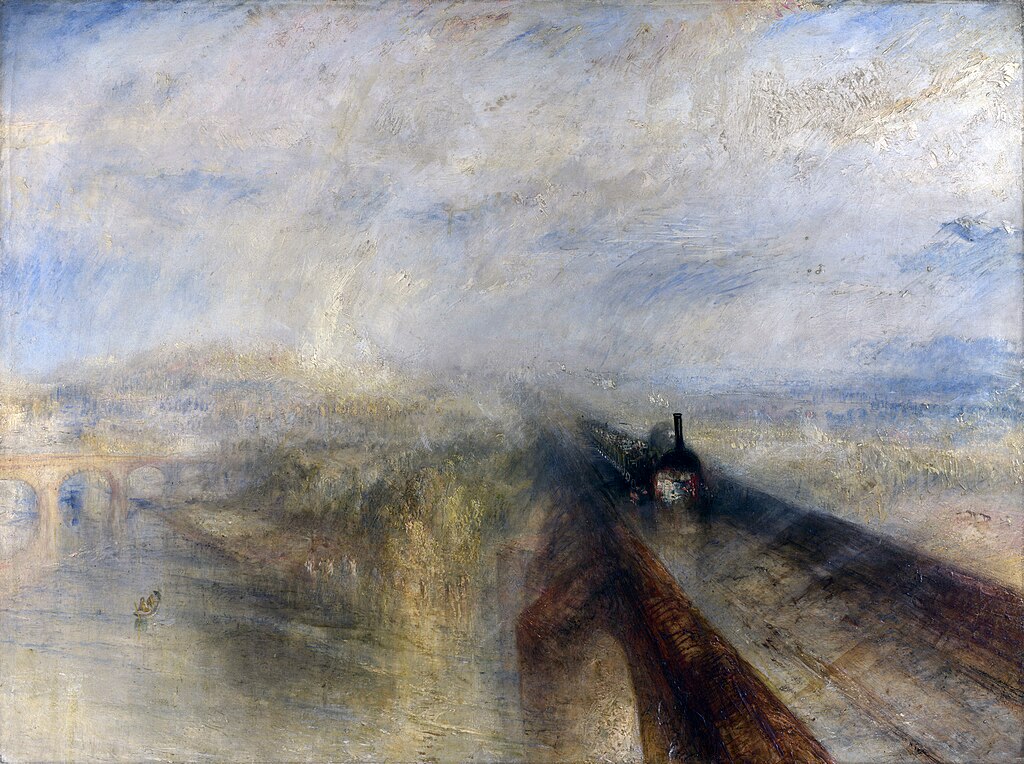
Rain, Steam and Speed – The Great Western Railway
Oil on canvas, 1844, JMW Turner
Bequest to the National Gallery, London
Through the history of art, paintings have been almost always representational, meaning that their subjects were of something identifiable – a flower, a nude, a landscape and so on. While the more cunning artists would at times bury meanings within their paintings, for the mass of viewers it was quite clear what the painting was of.

In the nineteenth century, when artists such as Joseph Mallord William Turner and the French Impressionists stepped away from strict representation, a degree of explanation was needed to educate viewers to a whole new way of not just painting, but of looking at the world. In the twentieth century, when representational art was overtaken by non-representational art, the radical ideas of the Impressionists were advanced ever more radically. In this new and non-representational art, there was no longer a clearly defined subject and so longer explanations were required. Or perhaps the artists, curators and other full-time denizens of the art world simply felt them necessary, in order to justify themselves.

Over the course of the previous century, those explanations became longer and longer. With time, art moved on again, from the non-representational with an explanation to, more or less, simply the explanation. This two-century move from what once may have been perceived as little more than a pretty picture, to something with almost no aesthetic appeal and a long explanation, has served to turn art into an intellectual pursuit. As such, its potential mass appeal has been considerably lessened. This may be why the popularity of artists such as Claude Monet and Vincent Van Gogh continues, since arguably they were among the last cutting edge artists to paint more or less representationally.

My bed
Mattress, pillows, linens, objcets
© 1998 Tracey Emin / Saatchi Gallery
In the first decade of the twenty-first century, as western affluence rose, so to did the disconnection between art and the public. Most people's experience of contemporary art became little more than reading in disbelief an article about the latest Turner Prize winner, or else about the escapades of a previous winners-turned celebratory millionaire.

Yet in the past few years, western affluence has been in a steady decline. This has helped reveal that many other institutions, most notably politics, banking and the media, seem to be reaching a similarly great point of disconnection with the public. For these institutions change has become not just something to be hoped for but something that would seemingly have become unavoidable. In the world of art, change appears already to be underway.

As the traditional methods for the dissemination of knowledge about art have lost either their credibility or their funding, and as with so much of our lives, the internet has taken over. Here is a quiet revolution, where much of the media and countless galleries who continue to peddle artistic alienation are being left for dead.

Dissolution chemistry
Mixed media on paper
© 2009 Megan Chapman
Through social media sites and online market places, the barriers that many saw between themselves and art are being pierced. So to in the real world, friendly faces are replacing stern and consequently, more and more people are becoming aware of the value of having art in their lives. It is a realisation that I experienced a few years ago, when I bought my first piece of art. I can vividly recall the experience.

I saw a painting I liked in an Etsy store, made by someone I knew only slightly (then) through a social media site. I liked it and realised that since it was a small paper piece, I could afford to buy it. This simple access to original art was a revelation. I saw how easy it was to own art and quite possibly always had been. For the life of me, I could not understand why I had never bought any before. So it was that with one or two mouse clicks, I became the owner of a piece of original art. In the time since then, I have bought (and traded) several more pieces of art and now have a collection that includes the work of more than ten artists. Buying art, I now realise, is like buying anything else. There is no great drama to it, no need for endless pondering or justification. If I see a piece that I like, I can simply buy it, or else negotiate payments or a trade. It is simple knowledge that I wish I had possessed for so much longer.

While most of these pieces in my collection are small, they are indistinguishably real and original art and they are on my walls. To sit among them is an indescribably pleasant feeling. I know each of the artists who made the work and so feel a personal connection to the pieces. I also feel that here, finally, is something permanent in my life, something that will with luck out last me and that perhaps some future generation will hold and enjoy and know that it was part of my life.

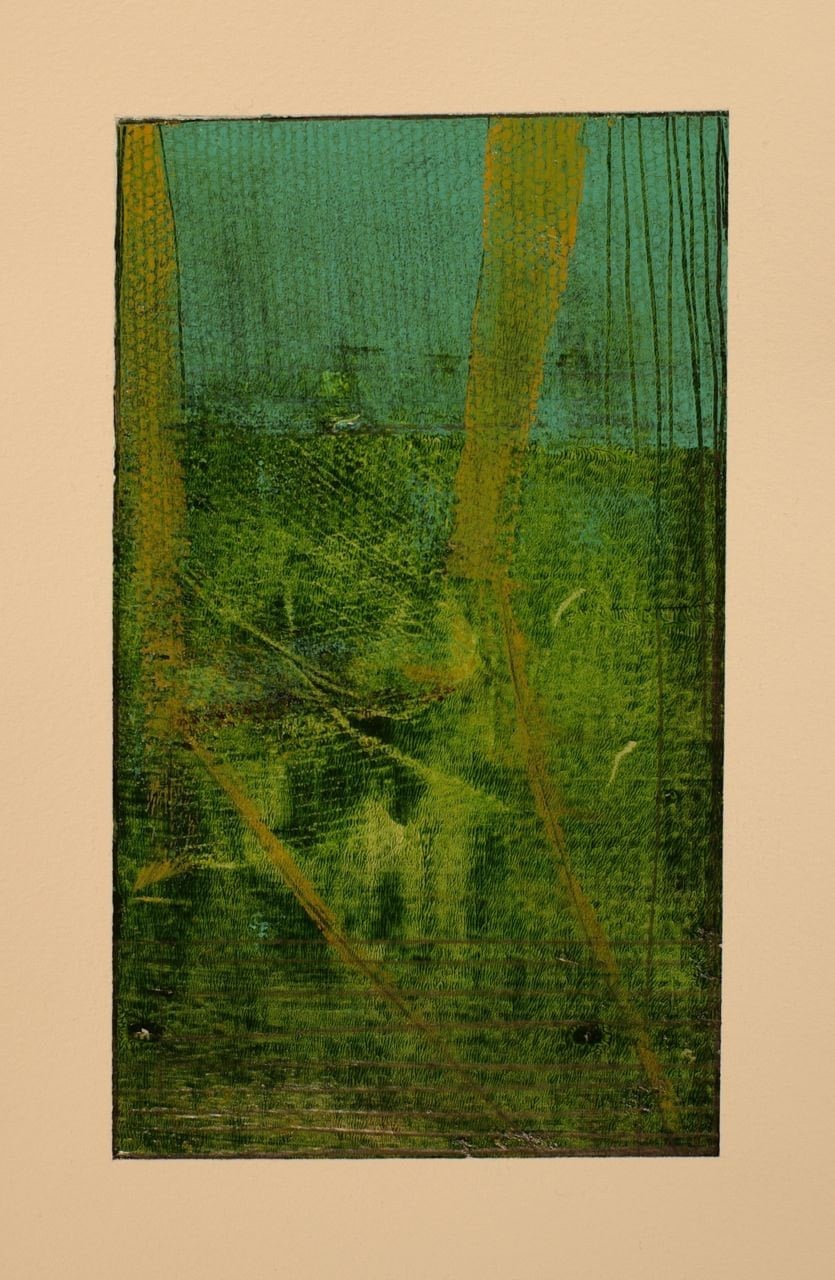
Uncharted territory
Mixed media on panel
© 2012 Megan Chapman
& Stewart Bremner
Paintings may still seem to many an unaffordable luxury, something only for those in the know. Happily this is an attitude that is changing. Although few of us might have the affluence we once did, we are now making our purchases armed with more knowledge and eager to shop ethically. Maybe now, rather than considering the next electronic gadget from a multinational corporation, a corporation that may well be both eroding your rights and employing semi-slaves, it is time to buy a painting from a real, live artist, an artist who will almost certainly be grateful because you have bought them more time to be an artist.

Sunday, 22 April 2012

It's all the rage

This week, Megan and I took a trip through England, visiting many big public galleries. In London we visited the Tate Modern, the National Gallery and the National Portrait Gallery; in Birmingham the Ikon Gallery and the Birmingham Museum & Art Gallery; in Manchester the Manchester Art Gallery. I learned that I have almost no affinity whatsoever for conceptual art and that, if I am to believe what I saw in some of these galleries, I am only interested in art that was made before 1950. Does this not make me seem rather like a philistine? It certainly made me feel like one and that was most unwelcome.

I have documented here my problem with conceptual art several times, going as far as to label it Fashion Art. I am now, frankly, tired of this it. I'm tired of seeing it in all the major modern galleries, I'm tired of talking about it with every artist I know or meet, I'm tired of getting angry about it and, most of all, I'm tired of thinking about it. And even with all of that, I still can't stop myself from once more rehashing my experiences of it.

Having seen so much of it in the past week, at the Tate Modern and Ikon Gallery, I feel like an idiot for not understanding it, for not caring one jot about it and for thinking that it is simply cannot be art. How can I call my self an artist and yet be so completely at odds with what seems to be the major art movement of my time? When I read "As the title suggests, Steel Zinc Plain represents a territory or a space as much as an object. By placing it on the floor rather than on a plinth and allowing it to be walked across, Andre alters the viewer’s relationship to the work of art" why do I keep shaking my head and wondering what I am missing, before feeling stupid and excluded? If I had been alive in the nineteenth century, would I have shunned those appalling new pieces by the so-called Impressionists, with all of their mess and unlife-like appearance?

Conceptual art depresses me. It depresses me because it is omnipresent, seemingly to the exclusion of every other contemporary art form. I want to see work invested with feeling, that has been wrought by artists using the hand, eye and heart, rather than this stuff of sensation and empty questions. Alternately, as an artist I could simply be jealous that conceptual artists appear to be swimming in the depths of accolades and money, while the sole of my foot is barely even wet.

I ought to take a lesson from this and totally avoid conceptual art in future. This, however, would appear to be no easy task at a time when there seems to be almost no other form of contemporary art on display in public galleries, almost as if each and every curator is dancing to the beat of one drummer, following in the wake of the unclothed emperor.

In many of our public galleries, we see vast spaces taken up with a small number of thin-seeming conceptual pieces, while enormous collections are held in storage, away from the public's eye. It seems wrongheaded, especially when one considers how disengaged audiences seem to be with conceptual art, compared to more traditional forms. At the Tate Modern viewers drifted through the spaces, never seemingly stopping for long, whereas in the National Gallery some paintings held constant and barely-moving crowds in front of them like magnets.

If we are to believe these admittedly-jaundiced memories, then something is clearly amiss. It would seem that many of those in charge of the public's art purse are purchasing and showing work that the public does not particularly care for.

Recently, Edinburgh's Fruitmarket Gallery held an Anna Barriball exhibition, that featured around twenty works lost in the brilliant white space of this mid-sized venue. On top of adding to the gallery's reputation for hosting unpopular and unlikeable art, it was shockingly empty when compared to the nearby Royal Scottish Academy. That building was playing host to the annual exhibitions of Visual Arts Scotland, the Scottish Society of Artists and the Royal Scottish Society of Painters in Watercolour, all at once. Here was an exhibition showing a cross-section of contemporary art; a vibrant, lively and attractive show, where walls had to be jammed full of paintings and which ran for only a month.

One of the many empty spaces in Sarah Browne's
How To Use Fool's Gold in Birmingham's Ikon Gallery.
Last week in the Ikon Gallery, another attractive mid-sized space, Sarah Brown's exhibition How To Use Fool's Gold took up one whole floor. This time less than ten pieces failed to fill the space. There seemed little unity in the work and if there was a vision for the exhibition it was far from evident. Once again an exhibition of contemporary work in a modern gallery lacked any emotion and had few visitors.

When most of the money and public gallery space in contemporary art is stuck to what appears to be vacuous gimmickry, it is not just the majority of artists who suffer, but the viewing public too. The artists starve or give up to take a soul-destroying job; the public turn away from art thinking they do not like it and live an unenriched life of corporate entertainment and large-screen televisions. We can surmise that, just as with our financial world where the 1% have all of the riches, so too the art establishment only notices the fashionable 1% (some of whom it would appear are even part of the financial 1%). It is a sad state of affairs.

The "Fighting Temeraire" Tugged to her
Last Berth to be Broken up – William Turner, 1839
Happily, our England trip was not totally consumed by conceptual upset – we also got to see justly famous artworks of beauty and emotion. At the National Gallery we saw several rooms of great Impressionist works, including Degas' Combing the Hair, as well as a wall of van Goghs and Turner's stunning Fighting Temeraire. Here Megan fell for even older pieces: Hans Holbein's The Ambassadors and Jan van Wyck's Arnolfini Portrait. Up north we particularly enjoyed two Modiglianis, with one in Birmingham and one in Manchester.

Our last stop at Manchester Art Gallery, turned out to be an unexpected highlight. With an impressive, well kept and well laid-out collection, covering an almost 700 year span, it packs an impressive punch for a gallery of its size. Its rooms of Pre-Raphaelite and Victorian art (including John William Waterhouse's Hylas and the Nymphs and Charles Mengin's Sappho) were a particularly treat, which was a genuine surprise given my previous lack of interest in work of that type.

While much of this work was often beautiful and even at times emotional, little of the contemporary work on show was either. I am an artist, who by very definition makes contemporary work, work that is, to me, both emotional and beautiful. Over the past few years I've met plenty other artists who are similarly engaged. I believe that this kind of work, made using the hand, the eye and the heart, would be well received by the viewing public, if only they knew of its existence.

Today I am part of the unfashionable 99% of artists. Being unfashionable does not upset me, neither does being one of the masses. What does upset me is the skewed perception of contemporary art that our public galleries foster. It think it is time for the 99% to get their turn. Who's with me?

Thursday, 16 February 2012

Cash rules everying around me

On first appearances, the world of art and the world of banking would seem to have few similarities. However, on pondering the current show at the Fruitmarket Gallery, it occurred to me that there was at least one.

Showing until April 9th, Anna Barriball's exhibition 'Exhibition' fills both floors of the gallery. Walking in with no foreknowledge, we were at first perplexed and then, finally, made somewhat angry by what we saw. Two dimensional objects, such as a five pound note, coloured in with ink; pencil rubbings made of doors and windows; rolls of graphite or paint-covered paper placed against the walls; found photos spotted with ink; a whole wall of stencil-patterning.

Here is art that is made using techniques common to primary education, masquerading as interdisciplinary work where "drawings are also sculptures, sculptures are drawings". These are basic techniques being exhibited as elitist art and I was utterly disengaged by them.

Without reading about the work, I saw nothing here but surface; a gallery of superficial 'art'. After reading the exhibition guide, which uses several hundred words to say almost nothing, I felt no more disposed to the work. More to the point, the long-winded descriptions of the pieces in fact angered me.

Anna Barriball, Untitled, 2009.
Pencil on Paper, 218 x 134 cm.
Private Collection.
"Much of the large-scale work in this exhibition Barriball makes through a process similar to taking a rubbing of an object: pressing with pencil or brush onto paper attached to different surfaces, directly transferring the texture of a window, wall, shutters or door onto paper. The body of dense markings possesses solidity, weight and mass despite the weightlessness of materials like paper and graphite. The direct transfer of surface texture and folds and creases produced through flattening volumetric elements creates a very close representation, a fusion of abstraction and figuration."

Of the ten paragraphs in the guide, of which this is one of the shorter ones, there is little more explanation of the work than this. Barriball's techniques are laid bare in rather grand eloquent terms, that try to disguise what could be seen as rather infantile mark making processes. If anything, rather than serve as an intermediary, an explanation that helps the views to enter the work, the guide slams the door in our faces. Like the art, it simply says that if you do not know and use the word 'liminal', you have no place here.

This exhibition is a retrospective and one where the majority of the pieces are called 'untitled'. There seems to be almost no evidence of artistic development, over the ten year period covered. Looking at the work, and the overblown claims made against it, it all seems like an inside joke that is trying really hard to be clever. This is exclusive and arrogant work and there is nothing here for anyone beyond the elite of the art world.

A few weeks ago, I commented on more conceptual art that is currently being exhibited in Edinburgh. In particular, I was unimpressed by Sol LeWitt's Wall Drawing #1136, a large mural concept that has been licensed to the Scottish National Gallery of Modern Art for eleven months (does anyone know if LeWitt works with Ikea?). At that time, a phrase popped into my head, which I kept to myself. That phrase, 'fashion art', returned to my head after seeing Barriball's work.

Fashion as we understand it in terms of clothes, is a superficial world. There is nothing beyond what you see on the surface. As a label, Fashion Art could be thrown at any art form, however this morning I want to throw it at Conceptual Art, because for me it seems the closest fit. When a piece of art looks bizarre or ugly to the majority, when it makes no impression on us, does not move us, when even the artist seems to have no explanation for it, who would call it anything but Fashion Art? There is no depth here, no meaning. It is not holding up a mirror to life.

The more I am exposed to the world of Fashion Art, the more come to I dislike it. Who is this work made for and who is buying it? It feels like a giant house of cards, waiting for the slightest wind to knock it over, when we shall see the emperor's new clothes for what they are.

Another place we may well see at least the first part of that horribly mixed metaphor is in our banking system. Yet it is not the house of cards in banking that first drew me to writing this piece. The similarity I see in banking and art is in the people who populate it. In both worlds, the mass of those working there are simply doing what they can do to get by. The motivations between the two groups may well be very different, but we all work and eat and live in the world. However, it is at the top of the ladder than I see the biggest similarity.

On both sides are groups of people, whose importance and renumeration are impossible to justify. It is hard to see why they are in the positions they are in. To many, it appears they have reached their positions by either bluffing their way to the top, or having known the right people and said the right things.

In both practices, the existence of these people bring their entire worlds into disrepute. They grab all of the headlines, as well as farcical sums of money, while at the same time having almost no connection to those that make up the majority of their worlds. It hardly seems to be a balanced system.

For some time, top artists have been thought by the masses to be in this unjustifiable position. Only lately have top bankers been recognised as being similarly located. At this time, following a seemingly endless cycle of banking crises, many are questioning why we have such 'top bankers'. In the world or art, where fewer and fewer artists are able to make ends meet, I think we need to ask a similar question.